

For many a year I’ve thought about going but never got around to it. This year however, I finally made the effort and I must say, it was well, well worth it. Sídhe an Bhrú, or Newgrange is only about ¾ hour drive, and at that hour of the day, there was little or no traffic, plus it was a Sunday, so the early morning rush was even lighter than on a weekday.

Only towards the end of our journey, did the volume of traffic increase, coming from all directions to this most special of places.

I must say that as my daughter and myself arrived, we were a bit concerned about the parking situation, but our fears were soon allayed as we realized just how well organized this event was. There were parking stewards everywhere, allowing a step-by-step route to where we could leave our car, a short walk from the interpretive centre. Once inside, staff were on hand to point out where the bathroom facilities were and to show us the way to the shuttle bus. Although there was a huge crowd, the buses arrived in quick succession, each holding approximately twenty-five per bus. Soon we were making our way through the entrance gate of the Sídhe an Bhrú site itself. Here the dawning, not only of the day, but of the significance of this ancient astronomical and sacred monument, was revealing itself to one and all.

Four days before Christmas, when Christians gather to celebrate, we are reminded that our ancient ancestors, long before Christianity, were also coming together, to acknowledge the shortest day, and look forward to the light returning to the dark and barren land. As we made our way up the hill, as many so must have done over 5000 years ago, there was that definite sense of pilgrimage, of paying homage to nature, and seeing the sunrise in a way that is far more elevated than our usual notion of taking each dawn for granted. On this particular day, we were very lucky with the weather, the rain had cleared and a fairly clear sky with wisps of light cloud shimmered in the pre-dawn glow.

What was particularly nice about this event for me, was that I was meeting up with a group from our Siúlóídí Gaeilge (Irish Walks) which occur in different locations every Sunday. The purpose of these walks is to give an opportunity to speak our native Irish language, at whatever level that is. Of course, Sídhe an Bhrú dates from a time long before Irish was spoken, and indeed the language of these people is lost forever, but still Irish is as ancient as it gets, the names of these monuments in our native tongue, reflect the stories and mythology associated with them, marking them as sacred spaces. The word Sídhe for example, relates often to the “fairies” or rather Fairy mounds and the word Brú can mean a bank, as of a river, or a mansion or palace. Truth be told, there are several interpretations of its name, each though, referring to its central importance in the ancient world. It is also associated with the Gods of our mythology, such as the powerful Dagda, or Aengus Óg, the God of love.
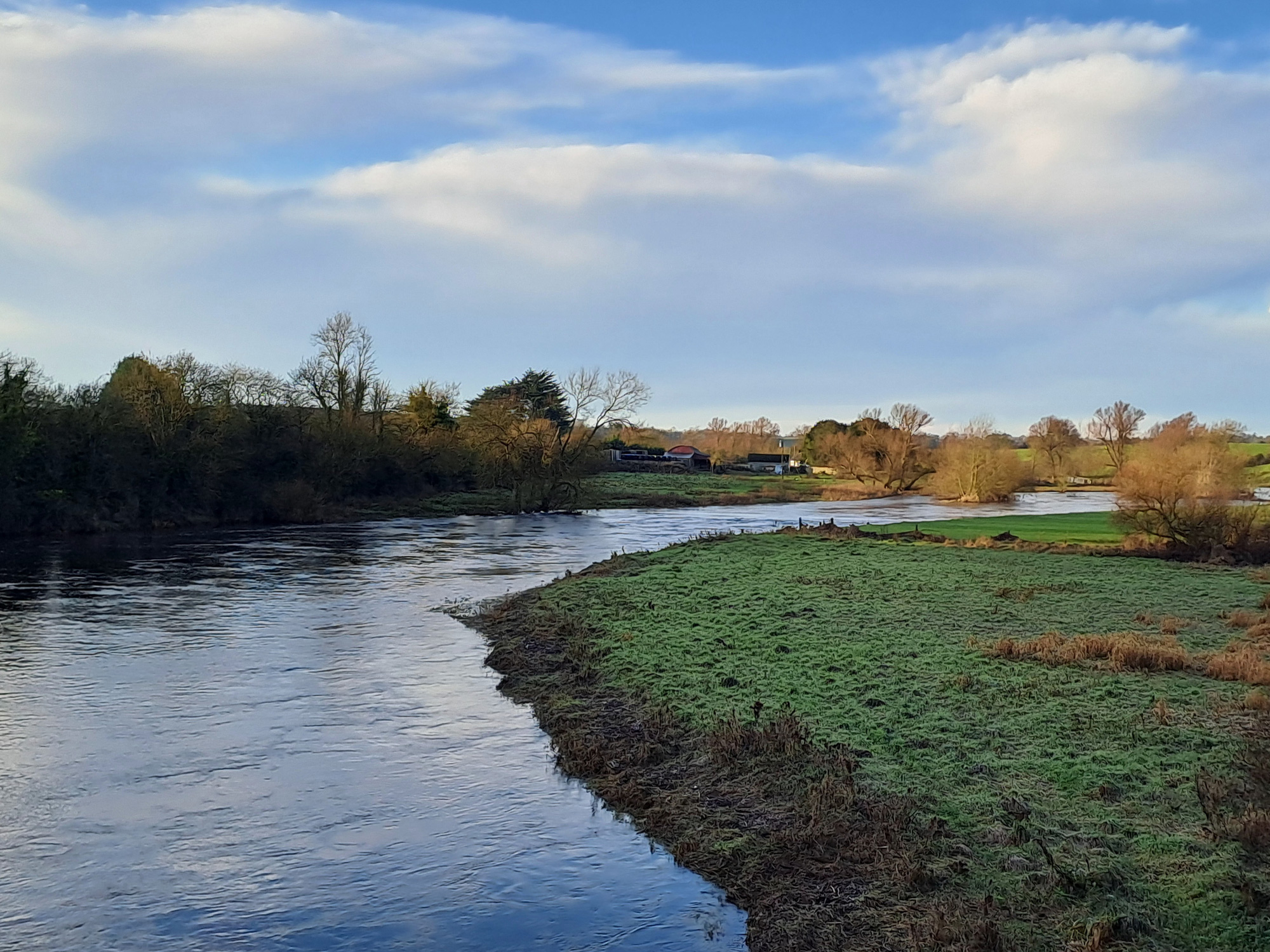

Once beside the mound itself, you cannot but be amazed by its magnificence, though its modern reconstruction, leaves a lot to be desired. Ignoring this 1970s interpretation, you are drawn to the ingenuity of these people, how they had aligned the roof box above the entrance to filter the dawn light of the shortest day, to find its way into the depths of the mound and light the chamber within. Only a few lucky souls who have earned their place by lottery, can actually witness this in person, but to be honest the magic and humility, in the face of this homage to light, was equally felt by all those who waited patiently for the sun to top the layer of hazy cloud on the horizon, almost with bated breath, as though in fear it might not happen. Below lies the River Boyne or Bóinn in Irish, named after the Goddess who dared walk “tuathal” or anti-clockwise around the magical well of Segais, so enraging the waters that they rose high to create a torrent which swept her to sea, and ultimately giving birth to the river Bóinn or Boyne as we know it in English. Looking across that River Boyne below our stand point, the low mystical mist seemed to rise from the earth to greet the sun, and as the first rays sent shafts of light from the still hidden sun, the atmosphere was electric, as bodhrans were beaten, hands were held in circles of dance, and everyone cheered as though they had never witnessed a sunrise in their life.

After it was over, I made my way to the mound once more, looking at the famous entrance stone with its symbolic Triskele, a feature which is repeated inside the monument itself, and I fingered my own small silver triskele, hanging on a chain around my neck. My thoughts went to my first cousin, its original owner, Marion Gunn, a renowned Gaeilgeoir (Irish speaker ), a folklorist and academic who sadly passed almost 10 years ago, and I knew she would be so happy to see us there, continuing the tradition of commemorating our olden ways and our native Irish language.

The journey back was as efficient as the journey there, the mighty queue for the buses melted away with the no nonsense approach to bringing people back to the centre as quickly as possible.
All in all, it was a fantastic morning, and one I hope to repeat in the future.
