
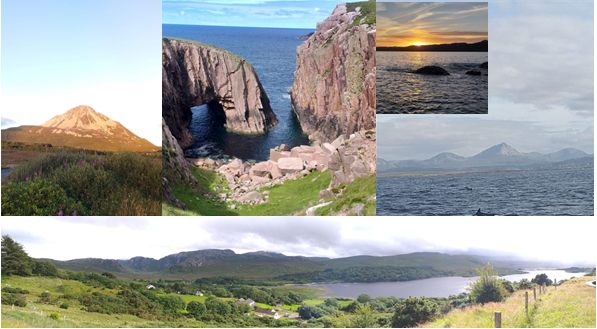
Contae álainn, lán le scéalta agus ár dteanga dúchais. A beautiful county, full of stories and our native language, Donegal was more than I ever realized. It was years since I'd been there but this visit in July was different as I took a week off by myself to do a course in Irish in the Gaeltacht, the Irish speaking area. Only since returning to our native tongue, do I understand the depth of history and mythology that are reflected throughout our land.
The wonderful Mount Errigal, comes from the old Irish meaning "oratory" and to be honest, it's easy to see how this could be so as it is a magnificent mountain. It was said to be named by the ancient Firbolgs who, coming from Greece, viewed Errigal as their own Mount Olympus. This majestic place is also the place where it is said that Lugh killed his grandfather and nemesis, Balor of the evil eye, whose poison is said to have then flowed in to the valley to create what is now known as the Poisoned Glen. I must say these are magical places to visit and you are struck with awe at the sight of Errigal. The village of Dunlewey lies in its shadow, the name in Irish being Dún Lúicthe or the fort of Lugh, once more connecting our place names to our mythology.
Being in Donegal, on the eve of Lúnasa almost was especially relevent as the Festival of Lúnasa/Lúghnasadh/Lúghnasa was one of the four half quarter day festivals in the ancient Irish/Celtic year. Falling at the beginning of August, it marked the mid-point between the Summer Solstice and the Equinox and was celebrated in remembrance of the God Lugh. As with Bealtaine, it has given its name to the month which followed, Lúnasa being the month of August in the Irish language, as May is Bealtaine. It was a festival associated with time of merriment and games, of arts and matchmaking. Lugh himself was son of Cian of the Tuatha Dé Danann and Ethniú of the Formorians, he was multi talented and often equated with being a Sun God (though this has been disputed) and said to be father to another hero of our mythology, Cú Chulainn. He is often called Lugh Lámhfhada (long armed), perhaps in reference to his magical spear and he possessed a hound by the name of Failinis. After the death of his Foster Mother, Tailtiu, Lugh held a festival in her honour where she was buried in Tailteann, Co. Meath. Here youths competed in an old Irish version of the Olympics and where music and the arts also flourished. Festivals such as Puck Fair in Kerry, Bilberry Sunday and indeed the climbing of Croagh Patrick, are all said to be remnants of this ancient festival.
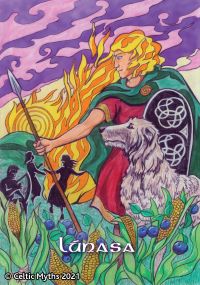
Here is my own image of Lúgh and the festival named after him. It encompasses the idea of the beginnings of the harvest, the music and dancing of Lúnasa, the magical spear and his faithful hound, Fáil Inis.
But everywhere in Donegal, the ancient stories prevail, and in even on the most distant island off our coast Oileán Toraigh, or Tory Island which is not a retreat for the a certain political party in England but rather, the name as Gaeilge (in Irish) refers to a place of steep cliffs. Certainly I can vouch for that as it has an amazing moonscape terrain, devoid of trees but strangely on the day we were there, a hot summer's day, there was a feel of the Greek islands with whitewashed and blue trimmed houses and walls. It is also a place full of culture and the Irish language is the daily tongue where traditional ways are still valued. Hard to believe that in legend, this was the place of Balor of the Evil Eye, the Formorian king whose people were dreaded by those on the mainland. To us, it was a wonderful, welcoming island, full of sea birds and wild ocean cliffs and even a dolphin pod accompanied our boat on our journey to shore.
Definitely a place to visit and learn of our ancient stories, to enjoy unbelievably pristine beaches and listen to the wonderful sound of our native language, alive and kicking!
